Riad website in Marrakech: turn high season into direct bookings
A good riad website in Marrakech has one job: turning the guests who find you on Booking.com or Google into direct bookings with no commission. It needs real photos, rooms with prices, a booking button that's always visible, WhatsApp, and clear directions through the medina. At Icarvs Studio it costs MAD 8,000–25,000 (about €740–€2,300), hosting included.
Contents
- Why does a fully booked riad still need its own website?
- What should a riad website include?
- Direct bookings: booking engine, enquiry form or WhatsApp?
- How do guests find your riad on Google?
- How much does a riad website with booking cost?
- How we build accommodation websites at Icarvs Studio
- When should you launch your riad website?
- Where to start
A lot of riads in Marrakech are run by owners who don't live there all year. You might be in Paris, Brussels or London, with a house manager on site, checking bookings on your phone between meetings. The rooms fill up for Christmas and Easter, which is great. Then the monthly statement arrives, and a large share of those nights came through Booking.com or Airbnb, each one with a commission taken off the top.
That's the most common situation when a riad owner comes to us for web design in Marrakech. Filling rooms isn't the problem. The problem is that guests who already know your name still end up booking through a platform, because your own site gives them no reason to stay. This guide is about fixing that, whether you manage the riad from the medina or from abroad.
Why does a fully booked riad still need its own website?
Because booking platforms bring you guests, but they keep the relationship. The guest books with them, pays them, and comes back through them next year. Commission depends on your contract, often around 15% and sometimes more once you add visibility boosts.
What actually happens is that many travellers search twice. They discover your riad on a platform, then type its name into Google to see more photos, read reviews or find a way to contact you directly. That second search is where your website has to show up, fast and reassuring. If it doesn't exist, loads slowly or looks like it was built in 2015, they go back to the platform and book there.
A website doesn't replace Booking.com. It wins back part of the bookings that could have been direct, and it gives past guests a place to return to.
What should a riad website include?
We see plenty of beautiful riad sites with a sunset rooftop video on the home page, where it still takes five clicks to find what a room costs. Guests want three answers quickly: what does it look like, how much is it, and how do I book. This is what goes on an accommodation site, in order of importance:
| Element | Why it matters |
|---|---|
| Real, recent photos | The courtyard, every room, the roof terrace, breakfast. Phone photos taken at noon put people off, however lovely the place is. |
| One page per room | Size, bed, bathroom, view, how many guests, and a "from" price. These pages can also rank on Google. |
| A booking button that's always visible | At the top of the screen and on mobile, with no searching. Most visits come from phones. |
| One-tap WhatsApp | Many guests want to ask something before paying. A quick WhatsApp answer often turns into a booking. |
| How to find you | The classic medina problem: the taxi stops at a gate, and then what? A map, a meeting point, and the airport transfer option. |
| Languages | English and French at the very least. Depending on your guests, Spanish or Italian can be worth adding. |
| Guest reviews | A few short ones, with a link to your Google or TripAdvisor reviews so people can check. |
| Clear policies | Cancellation, deposit, check-in times, children, tourist tax. Anything that isn't written down turns into messages and doubt. |
What we almost always cut: long paragraphs about "the Moroccan art of living", sliders that move on their own, and gallery pages with 80 photos and no captions. Guests don't read, they look and decide.
Direct bookings: booking engine, enquiry form or WhatsApp?
This is the real technical decision, and the answer depends on the size of your riad and how you already manage availability. If you run the place from abroad, it also depends on who answers guests day to day. There are three approaches, and they can be combined:
| Option | Best for | Strengths | Watch out for |
|---|---|---|---|
| Enquiry by WhatsApp or form | Small riads with an owner or manager on hand | Simple, personal, no extra tool | Replies have to be quick, or the guest moves on |
| Availability calendar plus enquiry | Riads with roughly 4 to 10 rooms | Guests see free dates before they write | The calendar must stay in sync with the platforms |
| Booking engine with payment | Riads that want confirmed bookings around the clock, or owners abroad | Booking and deposit with no one involved | Monthly fee for the tool, and settings that need care |
The biggest risk is double booking: the same room sold on Booking.com and on your site for the same dates. Before choosing anything, ask exactly how the website calendar will stay in sync with your platforms, or with your channel manager if you use one. If the answer is vague, that's a warning sign.
Our view: for most riads, start with a clear booking page, WhatsApp and an up-to-date calendar. A full payment system makes sense once the volume of enquiries becomes hard to handle by hand, or when nobody is available to answer at 2am.
How do guests find your riad on Google?
There are two searches to win. The first is your riad's name: when someone types it, your site should come up first, above the platforms. It sounds obvious, but plenty of riads don't manage it, because their site is slow, badly titled or barely indexed.
The second is searches like "riad in the medina with pool" or "riad near Jemaa el-Fna". Competition there is tough, and what helps most is:
- a complete Google Business Profile with photos, reception hours and reviews;
- a page for each room and one about the neighbourhood, with text written properly rather than copied;
- a site that's fast on mobile, because Google measures speed;
- the same name, address and phone number everywhere online.
That's ongoing work. If you want to go further, we first assess what your site needs, then run it month by month with a plan for SEO in Marrakech.
How much does a riad website with booking cost?
At Icarvs Studio, a site with online booking or ordering costs MAD 8,000–25,000 (about €740–€2,300). Where you land in that range depends on the number of rooms and languages, the booking approach you pick, and how much photography and copy you already have. Hosting is included, so there's no separate yearly bill. We break down everything that moves a quote in our guide to website costs in Morocco.
To see whether it's worth it, run a quick calculation with your own numbers. Here's an example to adapt:
- Average nightly rate: MAD 1,000 (roughly €90).
- Platform commission: 15%, so MAD 150 a night.
- If the website moves 100 nights a year to direct bookings, you keep an extra MAD 15,000 (about €1,400).
In that example, a mid-range site pays for itself within one season. Your real numbers may be faster or slower, but the calculation tells you quickly whether the project makes sense.
How we build accommodation websites at Icarvs Studio
We never start from a bought theme. First we work out where your guests come from, which languages they speak and how you handle availability today. Then we design the site in Figma and code it so it stays fast on a phone, even on an average connection. Most of our international projects run over WhatsApp and email, so being abroad isn't an obstacle.
The closest project to a riad in our portfolio is Le Bain Blanc, a hammam and spa in Marrakech. The brief was the same: make people want to come before they arrive, then let them book without three rounds of messages.
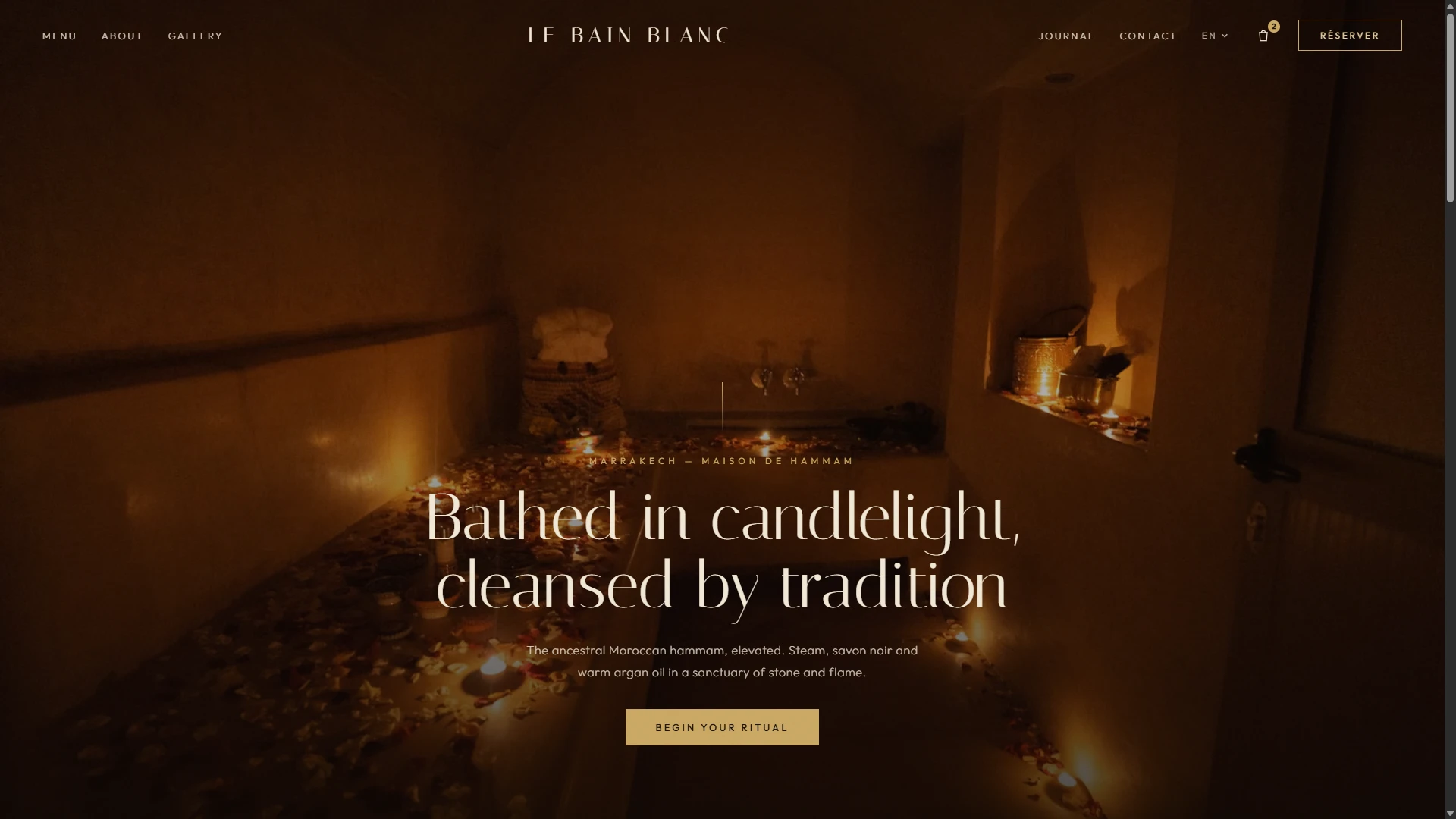
We took the same approach for Mawli, a Marrakech spa with an editorial site and appointment booking. For a riad, we keep that approach and add what matters for accommodation: rooms, directions and availability sync. All our projects are on our selected work page.
When should you launch your riad website?
Not in the middle of December, when you don't have a spare minute. The right time is before the season you're aiming for, because travellers book Marrakech weeks or even months ahead. For the spring season, February to April, now is when to start.
One practical tip if you manage the riad from abroad: sort out the photos first. Good photography is usually the slowest part to organise, because it needs the rooms empty, clean and well lit, ideally in the morning light of the courtyard. Book it during a quieter week, so the site isn't waiting on pictures when everything else is ready.
Timelines depend on the project. A simple showcase site can be up in about a week, while a site with a calendar and booking takes longer to set up and test. If you have an opening date or a season in mind, tell us from the start and we'll plan around it.
Where to start
Send us a WhatsApp message with these four things and we'll come back with a realistic estimate:
- Your riad's name and how many rooms it has.
- How bookings come in today: platforms, a channel manager, WhatsApp.
- The languages your guests speak.
- What you already have: photos, logo, copy, an old site.
You can also see what's included in every project on our web design page.
FAQ
Can a website replace Booking.com for a riad?
No, and it shouldn't try. Platforms are still useful for being discovered. Your site wins back the guests who are already looking for you, without paying commission.
How much does a riad website in Marrakech cost?
At Icarvs Studio, a site with online booking or enquiries costs MAD 8,000–25,000 (about €740–€2,300), hosting included. The price depends on rooms, languages and the booking approach.
How do you avoid double bookings between the website and the platforms?
The website calendar has to stay in sync with your platforms or your channel manager. Ask exactly how that will work before signing with any agency.
Can I manage the project from abroad?
Yes. Most of our international projects run over WhatsApp and email, without needing a meeting in Marrakech.